Cable and Solar Terminology: A Short Glossary for Buyers
Most disagreements between a photovoltaic buyer and a cable supplier come from four or five words rather than from price. Cross-section, strand build, XLPO, spark test and bending radius are all defined on the manufacturer's own pages, usually with a number attached. KUKA CABLE, a cable manufacturer in Jinshan District, Shanghai, publishes a 1500 V solar cable specification whose figures make the definitions concrete: 1.8/1.8 kV rated DC, a 10 kV spark test, a 6.5 kV AC test for 5 minutes and an ambient range of −40 °C to +90 °C. Anyone comparing quotations for cable solar products should keep this short vocabulary list next to the offers.
Key takeaways
- Cross-section is quoted in mm²; the published table runs from 1.5 mm² to 240 mm².
- Class 5 flexible conductor, to IEC 60228, describes the strand build rather than the current.
- XLPO is the electron-beam cross-linked, low smoke halogen free compound used for insulation and sheath.
- Bending radius is published as 4 times the outer diameter, so 4 mm² at 5.5 mm gives about 22 mm.
Cross-section, strand and conductor class
Cross-section is the area of copper in the conductor, quoted in square millimetres, and it is the number that appears in a product name. The manufacturer lists 4 mm², 6 mm² and 10 mm² as the commonly used specifications of its photovoltaic range and extends the same table to 240 mm². The second half of the same description is the strand build, which states how that area is made up: 56 strands of 0.29 mm at 4 mm², 84 strands of 0.29 mm at 6 mm² and 142 strands of 0.29 mm at 10 mm².
Conductor class is the third term in the same sentence, and it is the one buyers confuse with capacity. The pages describe the conductor as tinned copper of class 5 flexibility according to IEC 60228. Class describes how finely stranded and therefore how flexible the conductor is; it says nothing about how much current the cable may carry. A quotation that states a cross-section but not a class has left out the part that decides how the cable behaves when it is pulled around a mounting rail.
Insulation, sheath and the compound names
Insulation sits against the copper; sheath is the outer layer. Both are described on the 1500 V page as XLPO, cross-linked by an electron beam and characterised as LSHF, or low smoke halogen free. XLPO describes the polymer family, cross-linking describes the treatment that stops the compound softening at high temperature, and LSHF describes what the compound does not release when it burns. The published wall thicknesses are 0.7 mm of insulation and 0.8 mm of sheath for the sizes from 1.5 mm² to 10 mm², with thicker walls on the larger cross-sections.
Two temperature terms belong in the same paragraph because they are often mixed up. Ambient temperature is the range the installed cable is designed to sit in, published as −40 °C to +90 °C. Short-circuit temperature is the limit during a fault, published as +120 °C for 20,000 hours and +250 °C for 5 seconds. The first is a design condition, the second is an event, and a datasheet that gives only one of them has told half the story.
Test vocabulary: spark test, test voltage and elongation
A spark test is an in-line check performed as the cable is made, and the manufacturer publishes it at 10 kV. A test voltage is applied to the finished cable afterwards, and here it is 6.5 kV AC at 50 Hz held for 5 minutes. The two are not substitutes for each other: the first catches a defect in the insulation wall on the production line, and the second checks the finished length.
Elongation at break is the term that describes how far the sheath can stretch before it tears. The standard named on the product page requires more than 125% before ageing, and the manufacturer states that its photovoltaic cables typically run about 20% above the requirement, reaching up to 185%. Alongside it sit tensile strength, published as at least 8 N/mm² before ageing, and bending radius, published as 4 times the outer diameter. Related tests on the manufacturer's list include cold bending, cold elongation, abrasion, water resistance, UV accelerated weathering, solderability and static flexibility.
Certification and model-code vocabulary
Certification names are a vocabulary of their own, and the manufacturer's pages use them precisely. The standards row of the 1500 V specification reads TUV 2PfG 1169/08.2007, EN 50618:2014 and IEC 62930, while the certificates page lists more than 30 types of certificates including TUV, IEC, CE, SAA and UL and notes that the UL document is being updated. CPR is described as a fire rating and AD8 as a waterproofing rating, and both are regional requirements rather than cable properties.
Model codes are the shortest part of the vocabulary and the easiest to misread. H1Z2Z2-K and PV1-F are named model families on the site, alongside UL 4703 photovoltaic wire, a 1500 V solar cable and twin-core versions of the same construction. The connectors have their own names as well, with MC4 or solar connectors, fuse connectors, diode connectors and photovoltaic cable assemblies all published as separate products.
| Term | What the pages mean by it | Published value |
|---|---|---|
| Cross-section | Copper area of the conductor | 4, 6 and 10 mm² commonly used; table to 240 mm² |
| Conductor class | Flexibility of the strand build | Class 5 to IEC 60228, tinned copper |
| XLPO and LSHF | Compound family and fire behaviour | Electron-beam cross-linked, low smoke halogen free |
| Spark test and test voltage | In-line check and finished-cable check | 10 kV spark; 6.5 kV AC, 50 Hz, 5 minutes |
| Ambient and short-circuit temperature | Design range and fault limit | −40 °C to +90 °C; +120 °C for 20,000 h; +250 °C for 5 s |
| Elongation at break | Stretch before tearing, before ageing | At least 125% required; up to 185% published |
| Bending radius | Smallest radius the cable should be worked to | 4 × outer diameter, about 22 mm at 5.5 mm (author's calculation) |
Worked example
Suppose a buyer receives two quotations that use the same word differently. One states a 6 mm² conductor of class 5; the other states 6 mm² and nothing else. Check the published build: 6 mm² is 84 strands of 0.29 mm, a 6.0 mm overall diameter and 78 g/m. Taking the strand count and the strand diameter gives 84 × 0.29 = 24.36 mm of strand laid side by side, which is a rough sense of how fine the build is rather than a cross-section; that multiplication is mine and is only a sanity check.
Then check the radius. The published rule of 4 times the outer diameter gives 4 × 6.0 = 24 mm as the smallest radius I would work to for that size, and 4 × 5.5 = 22 mm for the 4 mm² build. Both are my own arithmetic on published diameters. A quotation that cannot state the strand build or the bending rule has not answered the question the glossary is meant to settle.
The company timeline behind the vocabulary
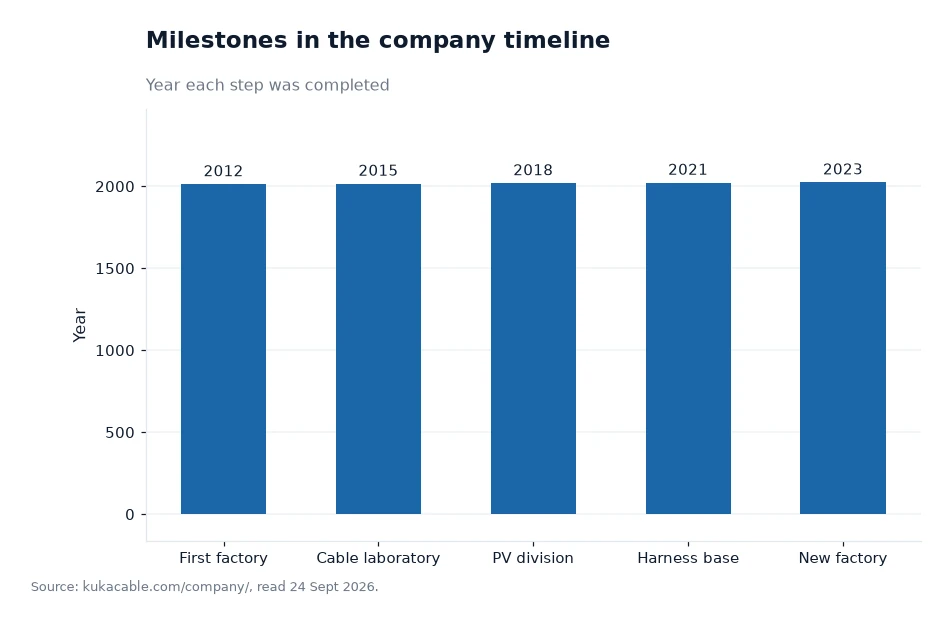
This chart describes the manufacturer rather than the cable, and it is included because the vocabulary above comes from a company whose photovoltaic division has been independent since August 2018. Reading the bars in order shows where the definitions were earned: the laboratory came in December 2015, roughly two years before the photovoltaic business was separated, and the harness base followed in June 2021. The gap between the laboratory and the division is about 32 months, which is my own subtraction on two published months.
Frequently asked questions
Does a larger cross-section mean a larger connector?
Not necessarily. The site publishes solar connectors, fuse connectors, diode connectors and photovoltaic cable assemblies as separate products, and the commonly used sizes are 4 mm², 6 mm² and 10 mm², with single-core and twin-core versions of each. The connector type has to be confirmed against the strand build rather than assumed from the cross-section.
What does class 5 flexibility actually tell a buyer?
It describes a finely stranded tinned copper conductor built to IEC 60228, which is flexible enough to be routed around frames and through trays. It does not state how much current the cable may carry, so capacity has to be confirmed by the designer against the installation rules for the site.
Keeping the glossary next to the quotation
Write the four terms that decide most comparisons on one line each: cross-section in mm², conductor class, compound, and the standard with its year. Add the published numbers that make each one checkable, such as 78 g/m at 6 mm², class 5 to IEC 60228, XLPO cross-linked by an electron beam, and TUV 2PfG 1169/08.2007 with EN 50618:2014 and IEC 62930. Then ask for the certificate copy and the datasheet for the offered model, because a glossary only helps if the words on the offer mean the same as the words on the page.
Each term and figure in this glossary was checked against the manufacturer's own site, with 24 Sept 2026 as the read date[1].