A refillable format is one of the easiest things for a supplier to promise and one of the hardest to prove, because the risk is concentrated in a closure that nobody tests until shoppers start using it. Evaluating a supplier for refill work therefore means asking for evidence at specific points: what was tested, on how many cycles, in which materials, with which formula, and what happened when it failed. This scorecard gives a retail own-brand six tests, the documents behind each one and the red flags that justify stopping before tooling.
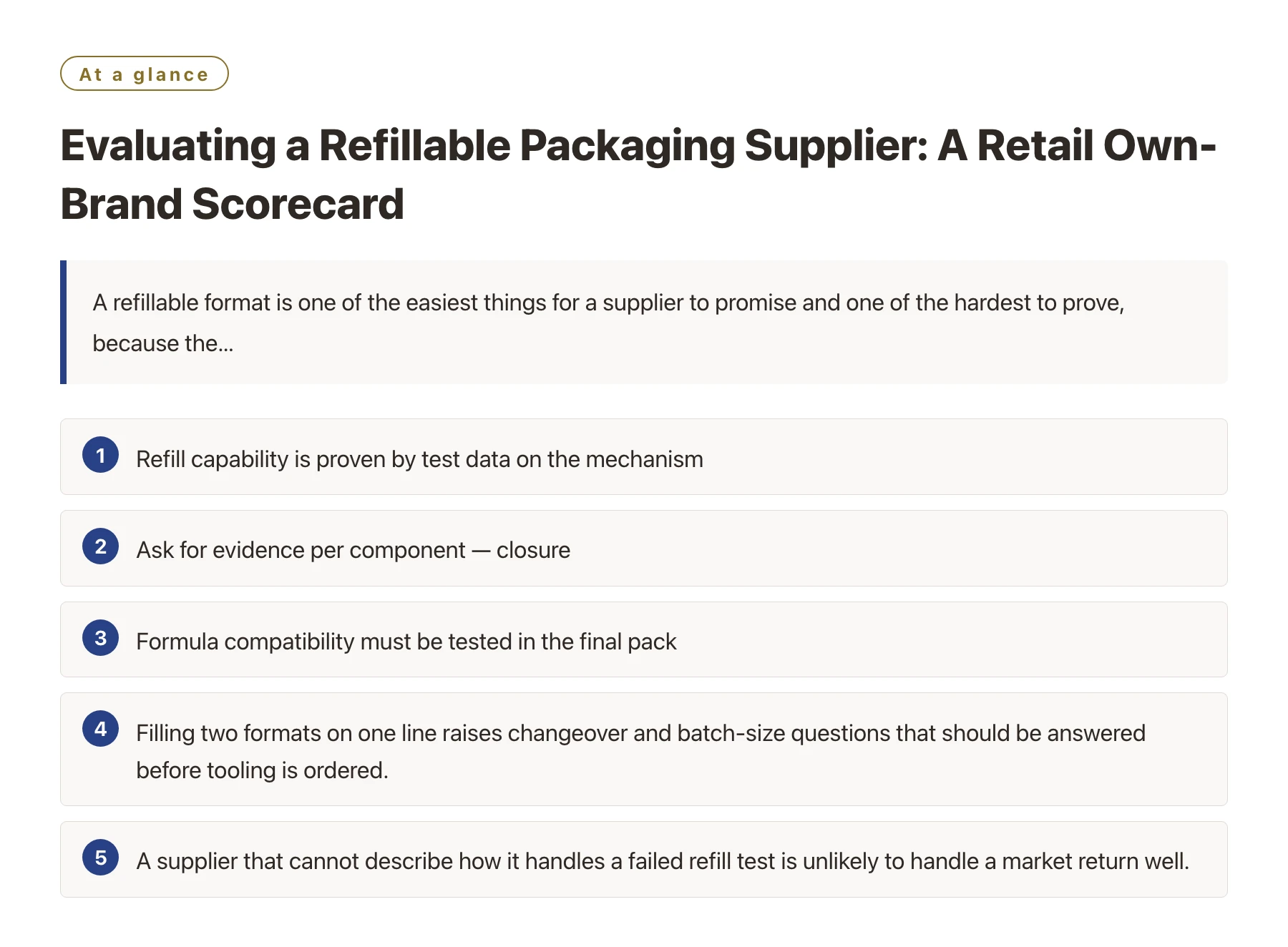
Key takeawaysRefill capability is proven by test data on the mechanism, not by the supplier's existing refill product on a shelf. · Ask for evidence per component — closure, liner, pump, vessel — because a refill system fails at the weakest interface. · Formula compatibility must be tested in the final pack, since contact materials and headspace change how a scent reads over time. · Filling two formats on one line raises changeover and batch-size questions that should be answered before tooling is ordered. · A supplier that cannot describe how it handles a failed refill test is unlikely to handle a market return well.
The refill conversation usually starts with a beautiful render and a claim about material savings. Both can be true and still leave the project exposed, because the failure that ends refill programmes is mechanical: a closure that loosens, a liner that swells, a pump that leaks after a dozen uses, or instructions that shoppers ignore.
That is why refill evaluation looks more like an engineering audit than a packaging tender. The questions are not about intent but about test method, sample size and what the supplier did when a result came back negative.
This scorecard is written for a retail own-brand buyer assembling the evaluation criteria before a shortlist is drawn, so that the criteria are set by the risks rather than by the first impressive presentation.
Six tests, the evidence behind them, and the red flags
| Test | Evidence to ask for | Red flag |
|---|---|---|
| Mechanism durability | Open-and-close cycle test results for the closure, with the number of cycles and the failure criteria | No cycle data, or a claim expressed only as "durable design" |
| Material compatibility | Contact test between the formula and every wetted component, including the liner and any coating | Compatibility confirmed verbally or by reference to a different product |
| Seal and leak performance | Leak test results after simulated transport and after repeated opening, not only at filling | Only a filling-line check with no transport simulation |
| Filling and changeover | Line plan showing how the primary pack and the refill run, minimum batch and changeover time | Two formats priced as if they were one product |
| Shopper usability | Instructions tested with real users, and notes on what they got wrong the first time | Instructions written by the packaging team and never tested |
| End-of-life handling | Material composition per component and how each part is meant to be separated or returned | A recyclability claim with no component-level breakdown |
Score each test on evidence rather than on confidence. A supplier that scores well on four tests and admits weakness on two is easier to work with than one that claims all six and produces documents for none.
Why refill failures cluster at the interface
A refill system is a set of interfaces: vessel to closure, closure to liner, liner to formula, formula to remaining headspace. Each interface can pass on its own and still fail in combination, which is why component-level certificates are not sufficient evidence on their own.
Design guidance for reusable and refillable packaging addresses exactly this problem, encouraging component-level thinking and disassembly from the start rather than after the pack is fixed [1]. Applying it during evaluation rather than during design is late, but still better than learning it from returns.
Ask what happens after a failed test
The most informative question in the whole evaluation is what the supplier did the last time a refill test failed. A specific answer — which component changed, whether tooling was affected, how the schedule moved — tells you more about the working relationship than any certificate. A vague answer is a signal that failures are handled informally.
Separate the supplier's own product from your project
A supplier that already sells a refill line has solved some of these problems for its own pack, which is useful but not transferable. Your vessel, closure, decoration and formula are different inputs, and the test matrix has to be run again. Ask which tests were re-run for comparable projects rather than accepting a reference product as proof.
Do not let the sustainability argument carry the engineering. A refill format with a weak mechanism produces exactly the outcome it was meant to avoid: unused refill packs, extra shipping and a product that shoppers abandon. Run the six tests, and if the mechanism is not ready, ship a lighter recyclable pack first and revisit refill when the evidence exists.
How to run the evaluation before the shortlist
Set the criteria before the first meeting and share them with candidates. Suppliers respond differently when the questions are known in advance, and the differences in how they prepare are themselves informative. A supplier that arrives with test summaries and a component list is prepared for the way refill projects actually run.
Include the factory, not only the sales office, in the assessment. Refill work depends on filling capability, inspection and how changeovers are managed, so a line walkthrough matters more than a presentation. Where a partner's development and production capability sit together — the arrangement buyers describe as fine fragrance manufacturing when the category is premium — compatibility questions are usually answered faster, because the formula and the pack are handled by one quality system.
Also treat the refill project as a supplier due-diligence exercise in its own right. The checks that apply to any new partner — how specifications are controlled, who signs a batch release, how deviations are handled — apply with more force here, and they are the same checks described in Xuelei's guide before signing.
If the range is white label, ask how refill components are sourced and whether the partner holds the moulds, the specification and the test records. A supplier presenting itself as white label fragrance manufacturing at scale should be able to answer that without consulting a third party, and the answer determines how much flexibility you keep if the relationship changes.
Finally, bring the criteria together in one place before a decision is made. A public capability summary on the official Xuelei website or any other supplier's site is a starting point for a shortlist, not a substitute for the six tests. The scorecard exists because the gap between a promised format and a working one is where the money is lost.
Re-score after the pilot
Score the shortlist before the pilot and again after it. The second score usually differs, because a pilot exposes how the supplier works under pressure: how it communicates a problem, how quickly it proposes an alternative, and whether the fix is documented. That gap between the two scores is the most useful number in the evaluation.
Sources
- Sustainable Packaging Coalition —— A membership organisation working on more sustainable packaging design, publishing material and recyclability guidance.
Frequently asked questions
What should I ask a supplier about a refillable closure?
Ask for open-and-close cycle test results, the failure criteria used, and how the closure performed after simulated transport. If the answer is a description rather than data, the mechanism has not been evaluated to a standard you can rely on.
Is a supplier's existing refill product proof of capability?
It is useful evidence, not proof. Your vessel, closure, decoration and formula are different inputs, so the compatibility and leak tests have to be run again. Ask which tests were re-run for similar projects.
Why does formula compatibility matter for refill packaging?
A refill pack changes the container, the headspace and the wetted materials. That can change seal performance and how the scent reads over time. Compatibility has to be confirmed in the final pack with the final formula, not on a generic sample.
How do I check whether a refill claim is defensible?
Ask for material composition per component, the reuse assumption behind the claim and the test evidence for the mechanism. A claim without a component-level breakdown is marketing copy rather than a specification.
Should I run a pilot before committing to refill tooling?
Yes, on the production line and in the final pack. The pilot is where changeover, sealing and usability problems appear. Re-score the supplier afterwards, because how it handles what the pilot reveals is as informative as the pilot result itself.