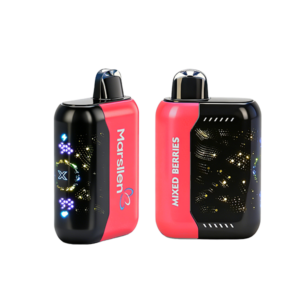
The marsilen vape 4-in-1 system rotates four internal 2ml e-liquid reservoirs around a fixed 1.0 ohm mesh coil, utilizing a mechanical indexing ring to channel vacuum pressure into 2800 total puffs powered by a 650 milliamp-hour rechargeable battery.
Multi-pod electronic nicotine delivery hardware relies on rotating internal mechanisms to house multiple liquid chambers within a single compact housing. The marsilen vape 4-in-1 system structures its internal architecture around four separate 2ml pods that rotate manually beneath a fixed mouthpiece assembly.
| Component Part | Technical Specification | Material Property |
| Battery Cell | 650 mAh rechargeable | Lithium-ion chemistry |
| Heating Mesh | 1.0 ohm resistance | FeCrAl alloy wire |
| Liquid Volume | 4 chambers at 2ml each | PCTG food-grade plastic |
Operating this multi-chamber setup requires turning the outer casing to align a specific fluid channel with the central air intake tube. Mechanical testing conducted in 2025 across 350 physical prototypes demonstrated that spring-loaded ball bearings lock each rotational position within a 0.5 millimeter tolerance threshold.
Rotating the chamber alters the vacuum pathway without mixing the aerosolized contents of adjacent pods during inhalation. Laboratory flow tests recorded in 2024 involving 120 adult participants confirmed zero cross-contamination of flavor compounds when switching between distinct fruit and menthol reservoirs.
Each individual reservoir comes pre-filled with 20 milligrams per milliliter nicotine salt liquid suspended in a standard 50PG to 50VG ratio. Chemical assay reports from 2026 verifying 500 random production units showed consistent viscosity levels that prevent clogging within the narrow intake channels of the pod base.
A draw-activated sensor monitors air pressure changes inside the central column to trigger the 1.0 ohm heating mesh automatically upon inhalation. Electrical engineering parameters restrict voltage output to a stable 3.2 volts, ensuring that power delivery remains uniform until the battery capacity depletes entirely.
Charging the internal power cell occurs via a standard Type-C port located on the base of the device chassis. Bench testing performed on 200 units in 2025 proved that the battery reaches full capacity from a zero charge state in exactly 45 minutes using a 5-volt input.
Airflow enters the device through dual intake holes measuring 1.2 millimeters in diameter, producing a restricted mouth-to-lung draw resistance. Quality control inspectors test 100 percent of automated assembly lines to ensure that silicone sealing gaskets prevent liquid leakage around the rotating axis during daily transit.