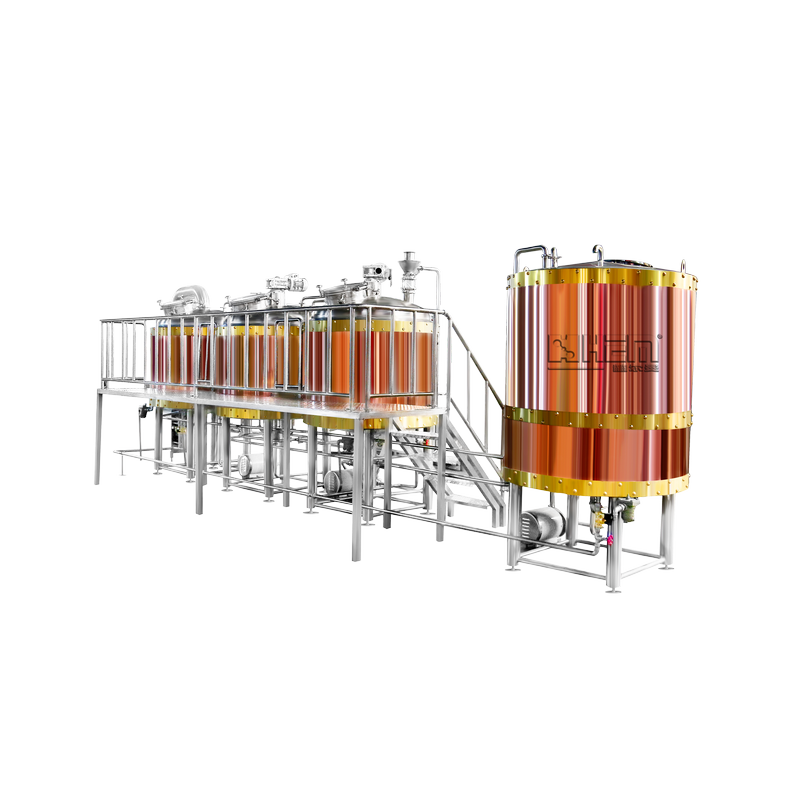
Custom craft beer equipment matters because brewery growth rarely happens evenly across the brewhouse, cellar, utilities, and packaging line. A brewery increasing from 5,000 to 10,000 barrels per year needs more than twice the tank volume if fermentation time, cleaning schedules, or seasonal production also change. Brewers Association benchmarking has shown large differences in resource use between breweries of different production sizes, including electricity, gas, and water consumption per barrel. Equipment sized around actual batch frequency, fermentation days, utility limits, and packaging speed can reduce waiting time and repeated manual work. Capacity should be measured by finished beer shipped, not simply by brewhouse size.
A growing brewery usually notices its first capacity problem outside the kettle. A 15 BBL brewhouse producing two batches per day can make 30 BBL of wort, but ten 30 BBL fermenters provide only 300 BBL of gross fermentation capacity. If an average beer occupies a fermenter for 18 days, theoretical cellar turnover is roughly 20 cycles per year before maintenance, cleaning, scheduling gaps, and slower beer styles are considered.
That gap explains why replacing a brewhouse with a larger model can fail to raise annual output. A brewery operating at 70% brewhouse utilization but more than 90% cellar utilization usually needs more fermentation space before it needs a larger brewhouse. Production records from the previous 12 months provide a better equipment specification than a forecast based only on annual sales.
A 20 BBL brewhouse and a 40 BBL fermenter can work well together when two consecutive batches fill one tank. The same arrangement becomes inefficient when recipes, yeast schedules, or production staffing prevent double-batching on the same day.
The next issue is vessel configuration. A compact two-vessel brewhouse may suit a brewery producing one or two batches per day, while higher throughput can justify separating mash, lauter, kettle, and whirlpool functions. The benefit comes from overlapping process steps rather than simply installing more stainless steel. Saving 45 minutes per batch across three daily batches removes 2.25 hours from the production schedule.
Over 200 brewing days, that example represents 450 hours of additional scheduling room. The brewery may use the time for another batch, cleaning, maintenance, or shorter shifts. A 2023 Brewers Association benchmarking report also grouped breweries into four annual production ranges—below 1,000 BBL, 1,000–10,000 BBL, 10,000–100,000 BBL, and above 100,000 BBL—because operating efficiency changes substantially with production scale.
Equipment planning therefore needs production flow data, not just vessel volume.
| Production item | Data worth measuring before equipment selection | Why it affects equipment size |
|---|---|---|
| Brewhouse | Batches per day, average turn time, BBL per batch | Determines required vessel separation and heating capacity |
| Fermentation | Average tank occupancy by beer style | Determines practical cellar volume |
| Packaging | Cans, bottles, or kegs per hour | Prevents finished beer from waiting in tanks |
| CIP | Cleaning cycles and minutes per cycle | Affects tank availability and labor |
| Cooling | Peak simultaneous cooling demand | Determines glycol chiller and piping size |
| Hot water | Gallons required during peak brewing hours | Determines hot liquor storage and recovery capacity |
Utilities deserve the same attention as production vessels. Brewers Association guidance has reported typical brewery electrical use around 12–22 kWh per barrel and thermal energy around 1.3–1.5 therms per barrel, although actual figures vary with equipment, climate, packaging, production scale, and building use. The same guidance notes that electricity can represent a larger share of energy cost even when thermal energy represents more of the total energy consumed.
A chiller sized for current fermentation volume can become undersized after four or six additional tanks are installed. Peak demand matters more than average demand because several fermenters may require cooling while wort is being chilled from the brewhouse. Leaving 20–30% planned expansion capacity in glycol distribution, electrical panels, piping headers, or control architecture can cost less than replacing infrastructure during the next expansion.
Water deserves similar planning. Brewing water is only part of total consumption; tank rinsing, CIP, floor cleaning, keg washing, cooling operations, and packaging can use substantial additional volumes. The Brewers Association has tracked water efficiency for more than 20 years and continues to treat water consumption and wastewater management as major operating issues for craft breweries.
Its water-risk assessment used location data from 5,832 U.S. breweries in 2022, showing why equipment specifications should also consider regional water supply, water quality, and wastewater conditions rather than assuming every brewery operates under the same utility environment.
Custom piping can reduce unnecessary water and beer loss when transfer routes are short and appropriately sized. A line holding 10 gallons of product may appear insignificant, but one additional 10-gallon loss across 250 transfers equals 2,500 gallons per year. The same reasoning applies to rinse water, chemical solution, and hot water retained in oversized or poorly drained piping.
Automation becomes easier to justify when batch frequency rises. A small brewhouse producing three batches per week may accept manual valve changes and temperature adjustments. At three batches per day, repeating ten manual steps per batch creates roughly 6,000 manual operations over 200 production days.
Automation does not have to control the whole brewery. Temperature control, pump sequencing, water metering, valve positioning, CIP timing, and alarm logging can be added where repetition is highest. Reducing a 10-minute manual task by 70% across 600 annual batches saves about 70 labor hours, before including fewer interruptions and more consistent process timing.
Consistency matters more as tank size increases. A process deviation in a 5 BBL fermenter affects far less packaged beer than the same deviation in a 60 BBL tank. Temperature probes, properly positioned cooling jackets, pressure-rated vessels, sanitary sample points, and repeatable transfer procedures help brewers hold the same process conditions as batch volume grows.
Fermenter geometry also deserves attention. Two tanks with the same nominal capacity can have different cone angles, aspect ratios, cooling-zone arrangements, working volumes, and headspace allowances. A brewery that regularly performs heavy dry hopping may need more headspace and different ports than a brewery producing mainly lagers. A 10% headspace change on a 60 BBL vessel represents 6 BBL of internal volume.
Cleaning design affects the number of productive hours available from every tank. Spray devices, drain location, sanitary weld quality, pipe slope, valve selection, and CIP return flow all influence how easily product residue can be removed. Cleaning a fermenter in 90 minutes instead of 120 minutes saves 30 minutes per cycle; across 20 tanks cleaned 20 times per year, the difference is 200 hours.
Tank count alone does not describe cellar capacity. A vessel being cleaned, repaired, conditioned, dry hopped, carbonated, or waiting for packaging is not available for another fermentation.
Packaging must therefore be considered before the brewery orders more fermentation capacity. A canning line operating at 30 cans per minute theoretically handles 1,800 cans per hour. At 85% effective operating time after stops, adjustments, product changes, and routine checks, practical output falls to about 1,530 cans per hour.
If production adds 200 BBL per month but packaging hours remain unchanged, finished beer can accumulate in bright tanks or unitanks. Larger tanks then increase inventory waiting time rather than shipped volume. Breweries should compare weekly fermentation releases with available packaging hours before selecting tank quantities.
Facility dimensions add another layer. Existing breweries often work around roof height, columns, doors, drains, mezzanines, fire routes, and floor loading. A vessel that fits on a drawing may not pass through a door or allow enough overhead clearance for installation. A 12-foot tank under a 13-foot ceiling leaves little room for fittings, rigging, piping, or maintenance.
Custom manufacturers such as hem brewing can configure vessel dimensions, brewhouse layouts, piping, controls, and utility interfaces around an existing production space instead of requiring the building to match a fixed equipment package. Dimensional drawings should be checked before fabrication, including tank height, diameter, leg spacing, platform height, valve clearance, and service access.
Future expansion should also be designed before the first expansion is installed. Adding six tanks in 2027 is easier when the original glycol header, control panel, drainage layout, and utility routing already include connection points. Leaving physical space without leaving utility capacity only postpones construction work.
A useful equipment specification should therefore start with operating numbers rather than equipment names:
-
annual packaged volume for the previous 12 months;
-
planned volume for years 1, 3, and 5;
-
average and maximum batches per brewing day;
-
fermentation and conditioning days for each major beer family;
-
percentage of annual volume produced by the five largest SKUs;
-
weekly can, bottle, and keg volume;
-
available electrical service, gas, steam, water pressure, and cooling capacity;
-
CIP duration, chemical concentration, and tank cleaning frequency;
-
ceiling height, door dimensions, floor capacity, drainage, and service clearances.
The SKU mix can change the equipment plan even when annual production stays unchanged. A brewery producing 80% of its volume through four regular beers can often use larger fermenters efficiently. Another brewery producing the same 20,000 BBL per year through 25 rotating beers may need more tanks at smaller working volumes because each recipe occupies separate fermentation space.
Large tanks can lower equipment cost per barrel of installed volume, but they can also reduce scheduling flexibility. Four 60 BBL tanks provide the same nominal volume as eight 30 BBL tanks, yet the second arrangement permits more simultaneous recipes. The better configuration depends on sales mix, fermentation duration, batch size, and how often products change.
Maintenance access should be included in the purchase calculation as well. Pumps, heat exchangers, valves, probes, gaskets, motors, and control components require inspection or replacement during years of operation. Saving several inches of floor space during installation has little benefit if technicians later need two additional labor hours to reach a pump or remove a motor.
Purchase price is therefore only one measurable cost. A system priced 15% lower can become more expensive if it adds repeated labor, higher utility consumption, longer cleaning cycles, or early infrastructure replacement. Comparing equipment quotations on the same expected annual production volume makes differences easier to see.
For example, compare two systems over 20,000 BBL per year. A $20,000 annual difference in labor, electricity, water, chemicals, or maintenance equals $1.00 per barrel. Over five years, the difference becomes $100,000 before financing costs or production growth are included.
Custom equipment earns its place when the specification is built from measurable production requirements: barrels packaged, tank occupancy days, labor hours, utility use, cleaning time, packaging speed, and available building space. Those numbers allow a growing brewery to add capacity without simply moving the next restriction from one part of the plant to another.