Closing the Month: Reconciling Shares on the Way to 0.1 BTC
An operator holding 250 TH/s through a full month should see roughly 0.00336 BTC accrue before pool lines at current difficulty, on the long road where 0.1 BTC needs 891.7 days. Month-end reconciliation turns that trickle into a verdict: expected against received, with downtime and difficulty drift accounted for. This piece gives small-farm keepers a repeatable closing routine built around four hashrate rungs.

Key takeaways
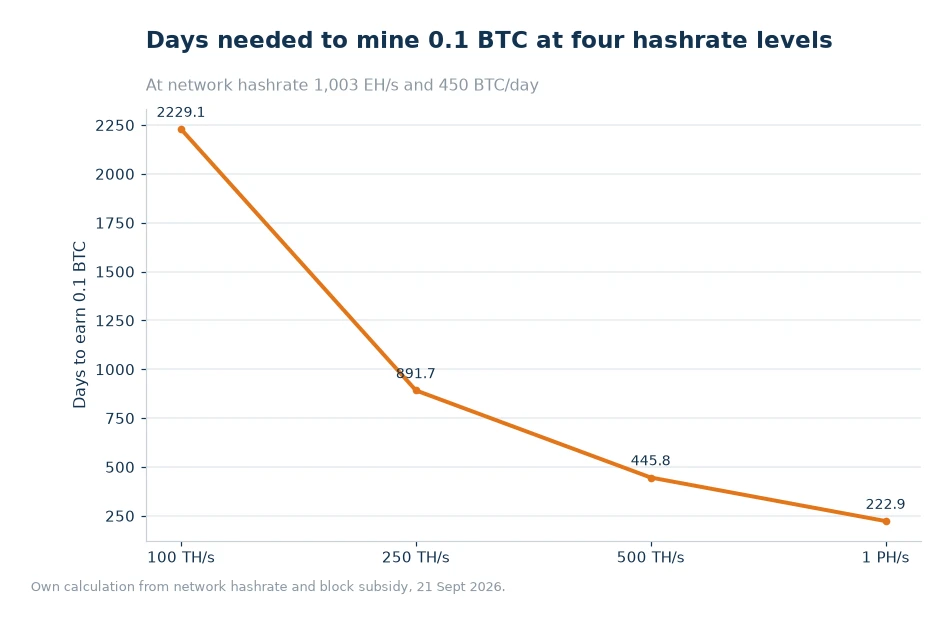
- 100 TH/s aims at 0.1 BTC in 2,229.1 days; 250 TH/s needs 891.7 days and 1 PH/s needs 222.9 days.
- A 30-day stretch at 250 TH/s should show near 0.00336 BTC before the listed settlement lines.
- Pool Hashrate frames pool capacity while Pool Luck explains block-count wobble around expectation.
- Reconcile monthly: average hashrate, expected coins, actual credits, then name the gap before acting.
Shut the books before judging the month
Reconciliation starts with freezing the inputs: export the month's daily credits, record average hashrate per worker, and note any dates machines sat idle. Memories of a bad week expand to fill the whole month unless the numbers are written down first. A closed month has boundaries — first credit to last — inside which every coin is either explained or flagged. Open-ended grumbling about disappointing returns never survives contact with a closed ledger.
Separate the ledger into three columns from the outset: what the hardware earned in expectation, what the pool credited, and what power and hosting consumed. The first column is pure network arithmetic, the second reflects settlement lines and payout rhythm, and the third belongs to contracts and utilities. Mixing them produces the classic error of blaming the pool for a power tariff or blaming the hardware for a fee line. Closed books keep each column honest.
Expected output from difficulty and nothing else
Expectation is a single division repeated per tier: hashrate over 1,003 EH/s, times 450 BTC a day. At 100 TH/s that yields 0.00004486 BTC a day; at 250 TH/s it yields 0.00011215 BTC; at 500 TH/s, 0.00022430 BTC; at 1,000 TH/s, 0.00044865 BTC. The ViaBTC Pool Hashrate view supplies the live context for these figures, showing pool and network totals that confirm which denominator the month actually used.
Multiply the daily expectation by days of real uptime — not calendar days — and the month's target appears. A 250 TH/s corner running 28 of 30 days should show 28 times 0.00011215 BTC, or 0.00314 BTC before settlement lines. If the statement reads close to that less the listed deductions, the operation is healthy and the month simply reflects difficulty as it stood. If it reads far below, the shortfall's size points at its cause: small gaps whisper fees and drift, large gaps shout downtime and dead boards.
Four rungs toward a tenth of a coin
The chart behind this article stretches the same division toward a 0.1 BTC milestone across four tiers, and its spans sober up any planning session. Two thousand-plus days at 100 TH/s, under nine hundred at 250 TH/s, mid-four-hundreds at 500 TH/s, and just under 223 days at a full petahash. Those are expectation horizons at frozen difficulty, useful for sizing ambition rather than promising arrival dates.
Read the table for the tier you operate and convert its daily row into a monthly one by multiplying by thirty. That monthly figure is the number the bookkeeper should see credited, less settlement lines and less any idle days. Operations that clear this bar month after month own a genuine baseline; only then do upgrade debates, tariff renegotiations and settlement switches rest on measured ground instead of restless instinct.
Telling luck gaps apart from downtime gaps
Two very different shortfalls hide inside a disappointing month, and the fix for each is opposite. A luck gap appears when Pool Luck reads soft for weeks: blocks arrived slower than statistics suggested, and under PPLNS that weather reaches miner statements through shares counted across the last 5 difficulty rounds. The response is patience plus a longer window, because fortune mean-reverts while panic-switching merely restarts the sample.
A downtime gap shows in the hashrate column, not the luck column: average terahash sagging below rating across days, with credits tracking the sag faithfully. Dust-clogged sinks, summer heat, failing supplies and stale firmware all sign their names in that column. Under PPS+ the diagnosis is especially clean, since block-reward credits settle hourly against current difficulty and mirror actual shares without pool-fortune fog. Fix the machines, and next month's reconciliation clears itself. The multi-currency wallet keeps received coins visible in-account during the review, and the ViaBTC App lets a keeper verify curves without driving to the shed.
Records your future self will thank you for
Keep one row per month: average hashrate, uptime share, expected coins, credited coins, price average, and power spend. Six columns, twelve rows a year, and suddenly difficulty eras stop blending together in memory. When a quarter disappoints, the sheet shows whether hashrate sagged, difficulty climbed, price slid, or the tariff bit — four different stories demanding four different responses.
Archive the pool statements alongside the sheet, including the settlement choice in force each month. PPS+ months arrive with hourly granularity that auditors love; PPLNS months carry confirmation-batch shapes that need a note explaining the 6-confirmation rhythm. A future accountant, partner or buyer will pay a premium for operations whose history reads as arithmetic rather than anecdote.
| Operator tier | Daily BTC | Days to 0.1 BTC | 30-day BTC | Calendar feel |
|---|---|---|---|---|
| 100 TH/s | 0.00004486 | 2,229.1 | 0.00135 | about six years |
| 250 TH/s | 0.00011215 | 891.7 | 0.00336 | under two and a half years |
| 500 TH/s | 0.00022430 | 445.8 | 0.00673 | near fifteen months |
| 1 PH/s | 0.00044865 | 222.9 | 0.01346 | near seven months |
Worked example
Verify the 250 TH/s row stepwise. The per-terahash day is 450 over 1,003,000,000 BTC, or 0.00000044865 BTC. Times 250, the day holds 0.00011215 BTC. Dividing the 0.1 BTC milestone by that day gives 891.7 days, exactly the chart's second point. A thirty-day month at full uptime stacks 30 times 0.00011215, or 0.00336 BTC before settlement lines.
The companion rows follow the same two divisions. At 100 TH/s the daily 0.00004486 BTC stretches the milestone to 2,229.1 days with a 0.00135 BTC month. At 500 TH/s the daily 0.00022430 BTC means 445.8 days and a 0.00673 BTC month. At 1,000 TH/s the daily 0.00044865 BTC compresses the wait to 222.9 days with a 0.01346 BTC month. The chart note's 4.5e-07 per-terahash day is this divisor in rounded dress.
Frequently asked questions
What should a 250 TH/s month show?
Near 0.00336 BTC for thirty full-uptime days at current difficulty, before the listed settlement lines, since each day targets 0.00011215 BTC.
How do Pool Hashrate and Pool Luck enter reconciliation?
Pool Hashrate confirms the capacity context behind the month, while Pool Luck explains block-count wobble; under PPS+ hourly credits track difficulty rather than that wobble.
When is a shortfall the pool's business at all?
Only when credits trail expected coins while hashrate held rating and difficulty is accounted for — otherwise the gap belongs to downtime, heat, firmware or power.
File the sheet and let the rigs hum
Close each month the same way: freeze the data, fill the six columns, name the gap in one sentence. Months that reconcile within a narrow band earn no action beyond continued operation. Months that miss earn exactly one corrective task, aimed at the column the numbers indict.
Over a year, those sheets become the operation's memory and its negotiating hand — with power suppliers, hardware sellers and partners alike. Targets like 0.1 BTC stop being distant dreams and become dated rows in a ledger, approached at 0.00011215 BTC a day per 250 TH/s, one closed month at a time.
Sources: ViaBTC pool, wallet and fee pages for Pool Hashrate display, account balances and the listed PPS+ and PPLNS lines; chain inputs read 21 Sept 2026 (network 1,003 EH/s, difficulty 132.76 T, subsidy 3.125 BTC per block, 144 blocks a day), published 24 Oct 2026[1].